90 or 120 minutes · 3–5 players · System-neutral
The Folded Orchard
An orchard has folded like a paper map. Familiar paths meet at impossible angles, and a seed cart waits inside a crease while the keeper’s map shows a route nobody has walked.
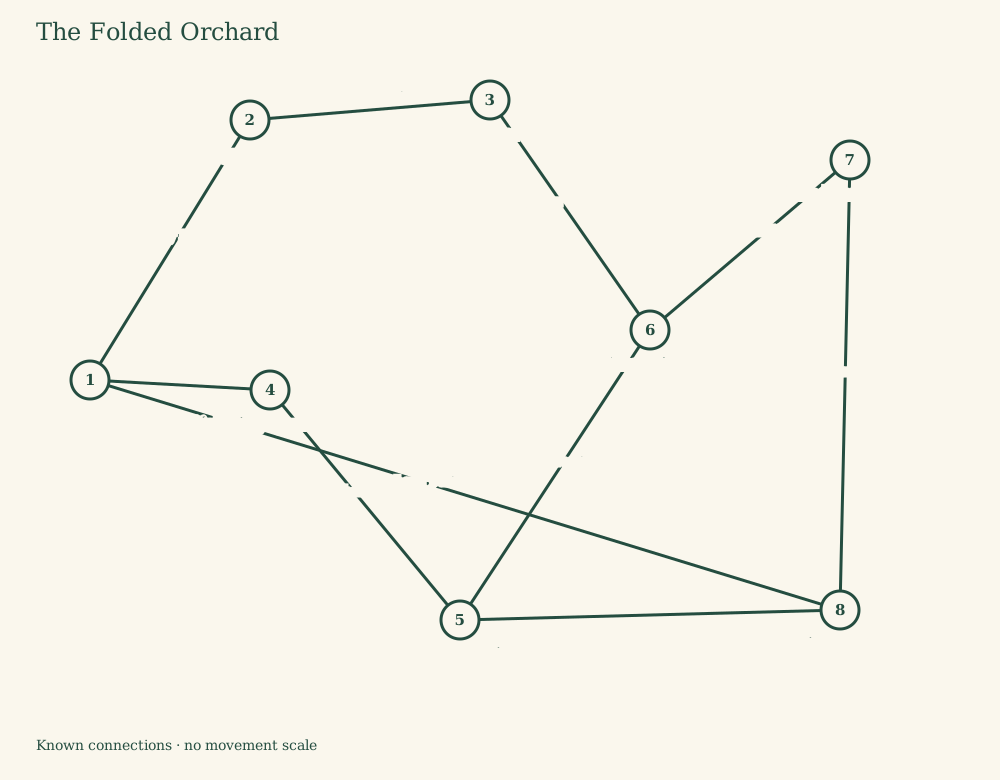
A first look
The orchard gate opens onto a path that bends upward like the corner of a page. Beyond it, a small cart bell rings from somewhere too near and too far at once. Lio holds a paper survey by its edges. “I folded out the wind,” they say. “I forgot that the cart was still on the map.”
Inside your pack
- 9 authored places and 12 connections, with a separate GM decision map.
- 4 NPC cards with goals, offers and boundaries.
- 4 discovery cards with something players can compare, arrange or decide.
- 3 possible closures, including a partial result when the preferred plan fails.
- A one-page GM reference, complete GM book, public player book and state sheet.
- PDF, self-contained HTML and SVG files for offline use.
Two complete routes
90 minutes: Trace one shortcut or take the boundary
Introduce the listening-row bell as an optional detour; follow press–north–cistern for a four-interval repair. Five intervals allow one meaningful change of plan, while using the perimeter preserves a clip but leaves the folds.
120 minutes: Map both circuits and compare cart exits
Walk the southern circuit before consulting the press, so discovery visibly changes the already explored map. Seven intervals permit both stabilizers and a perimeter contingency, but only two clips remain available.
Read the full GM book — contains spoilers
The Folded Orchard
120-minute plan · 4 players · Explore changing places An orchard has folded like a paper map. Familiar paths meet at impossible angles, and a seed cart waits inside a crease while the keeper’s map shows a route nobody has walked. Content notice: Changing paths and mild disorientation. All routes are firm and visible; characters can return to the gate whenever they choose.
GM overview
Use the nine-location map and two clip tokens. Travel is free except the long cart haul, which spends two trail intervals. The orchard has two visible circuits sharing the cistern and low bridge. The press shed supplies the crease tracing; examining it discovers the hidden Low Crease, but walking that shortcut also requires a level water reflection. A north terrace counterweight makes one fold stable; the cistern alignment levels the reflection. With both, the cart pocket can be opened gently and the orchard flattened. Alternatively, secure the cart and haul it through the perimeter without consuming a clip at the north terrace; that saves the seeds while leaving the orchard folded for a later survey. Locations offer different information and work: the listening row locates the bell, the bridge provides a public crossing, the windbreak provides an alternate cart exit, and the press shed reveals the low crease on an older survey. Do not move map connections arbitrarily for atmosphere. Every change is represented by a discovery or state condition.
What is really happening
Keeper Lio folded the orchard’s living survey to shelter blossom from a hard wind. Two survey creases remained clipped together, placing the seed cart inside a folded pocket. A counterweight at the north terrace and a straight water reflection at the cistern stabilize the folds. Discovering the low crease opens a cart shortcut; walking the orchard’s long perimeter can also bring out the seeds without flattening the whole orchard.
Opening agreement and read-aloud
Agree on subjects to soften or skip. Each player names an ordinary skill and a reason to help. Evidence does not require a successful roll; uncertainty changes time, cost or obligations. The orchard gate opens onto a path that bends upward like the corner of a page. Beyond it, a small cart bell rings from somewhere too near and too far at once. Lio holds a paper survey by its edges. “I folded out the wind,” they say. “I forgot that the cart was still on the map.”
Time and preparation
120 minutes: Map both circuits and compare cart exits Opening agreement: 10 minutes Locate the bell and cross the stable bridge: 25 minutes Read the reflection and old survey together: 25 minutes Compare the hidden crease with the perimeter: 25 minutes Commit clips, recover the cart, and redraw the orchard: 25 minutes Closure and debrief: 10 minutes Walk the southern circuit before consulting the press, so discovery visibly changes the already explored map. Seven intervals permit both stabilizers and a perimeter contingency, but only two clips remain available. Starting information: Discover cards in play Starting state: Survey and hauling intervals = 7; Wide survey clips = 2; North fold counterweighted = false; Cistern reflection straightened = false; Low crease traced = false; Seed cart secured = false; Seeds at the gate = false; Cart bell located = false With 4 players: share the roles of mapper, evidence keeper, speaker and timekeeper.
If the group gets stuck
Blocking bridge–cistern still leaves gate–press–north–cistern, while blocking the cart shelf leaves bridge–windbreak–pocket. If the group never traces the crease, the perimeter haul still works. A missing printed survey may be inspected again at the press as the physical map; record the discovery explicitly. If clips or intervals are exhausted, mark-and-withdraw leaves everyone safe and the cart explicitly unrecovered.
Orchard gate
Read aloud: The gate’s shadow falls in the right direction. Every other shadow seems folded once. GM: This is the fixed reference point and safe return. Lio stays here with the living survey. Returning with seeds is enough for the alternate ending; flattening requires both stabilizers.
Choice: Receive the seeds and schedule a later survey
Ask: Confirm the cart’s return while recording which fold still needs attention. Requires: Seeds at the gate is true. Result: Lio checks the dry sacks at the gate and dates the unfinished survey work. Closure: Seeds out, folds remembered
Survey press shed
Read aloud: An older sheet has a thin dotted line across a corner the current map keeps hiding. GM: Tracing the older dotted line discovers the Low Crease. The two clips are already in inventory; examining the shed gives their possible uses and does not add more.
Choice: Trace the dotted crease on the older sheet
Ask: Connect its two landmarks and reserve a clip for the cart before spending the other. Requires: Available. Low crease traced: true. Reveal Two survey creases. Discover Low crease passage Result: The Low Crease appears as a known route, waiting for a straight cistern reflection.
North blossom terrace
Read aloud: Blossom branches lean with the ridge, and a counterweight hook hangs beside a broad survey tab. GM: One clip and one interval hold the north fold. This is needed for full unfolding but unnecessary for a perimeter cart rescue, creating a real inventory decision.
Choice: Clip the north counterweight to its survey tab
Ask: Spend one clip and one interval stabilizing the fold for a full repair? Requires: Available. Spend 1 Wide survey clips; Spend 1 Survey and hauling intervals. North fold counterweighted: true Result: The blossom terrace holds its position and one of the map’s two creases stops pulling.
Listening apple row
Read aloud: The bell sounds loudest when your ear rests near the third tree, where a row appears to continue behind itself. GM: Listening identifies the pocket as the cart location and supplies the bell card. It is useful orientation, not a mandatory password for movement.
Choice: Compare the bell from three trees
Ask: Mark where the evidence points without treating echoes as a traversable path. Requires: Available. Cart bell located: true. Reveal Listening-row bell notes Result: The clearest bell points toward the cistern’s cart shelf.
Low stone bridge
Read aloud: The bridge is ordinary stone. The trees reflected beneath it form a neat line until the water reaches the cistern bend. GM: This stable crossing joins the two orchard circuits. If its east edge is blocked, the press–north–cistern route still reaches the pocket.
Mirror cistern
Read aloud: Two reflected paths stop a finger’s width apart. A measuring reed rests beside an adjustable map peg. GM: Aligning the reflection costs one interval and requires no clip. It opens the discovered Low Crease shortcut. The water never needs to be entered.
Choice: Read the dry-bank measuring strip
Ask: Separate what the water adjustment changes from what the north counterweight changes. Requires: Available. Reveal Cistern alignment strip Result: Orren marks two different stabilizers on the group’s survey.
Choice: Straighten the reflected rows from the dry bank
Ask: Spend one interval moving the map peg until both reflections meet? Requires: Available. Spend 1 Survey and hauling intervals. Cistern reflection straightened: true Result: The reflected rows meet. Any traced low crease becomes a continuous dry path.
Folded cart pocket
Read aloud: The seed sacks are dry. The cart bell rings whenever a folded branch brushes its handle. GM: Securing the cart costs one clip and one interval. Full unfolding may then use both stabilizers; alternatively haul the cart by the windbreak, spending two more intervals.
Choice: Check the cart and compare both exits
Ask: Count the remaining clips and hauling intervals before selecting the route. Requires: Available. Reveal Seed cart route board Result: Pippa confirms the seed sacks are dry and the cart can travel either marked exit.
Choice: Clip the seed cart to the stable survey
Ask: Spend one clip and one interval securing all four wheels before changing the fold? Requires: Available. Spend 1 Wide survey clips; Spend 1 Survey and hauling intervals. Seed cart secured: true Result: The cart sits steadily on the survey and can be hauled without tipping its seed sacks.
Choice: Release the two stabilized folds together
Ask: With both stabilizers set and the cart secured, spend one interval flattening the orchard? Requires: North fold counterweighted is true and Cistern reflection straightened is true and Seed cart secured is true. Spend 1 Survey and hauling intervals. Seeds at the gate: true Result: The orchard settles flat. Pippa rolls the cart along its ordinary lane to the fixed gate. Closure: An orchard with room to grow
Old windbreak lane
Read aloud: Tall woven screens hold the wind away from a lane broad enough for a seed cart. GM: The perimeter haul here is the reliable cart exit. It does not flatten the orchard and has room for every character to help without a strength roll.
Choice: Haul the secured cart along the outer boundary
Ask: Spend two intervals bringing out the seeds while leaving the orchard folded? Requires: Seed cart secured is true. Spend 2 Survey and hauling intervals. Seeds at the gate: true Result: The whole group brings the seed cart along the firm boundary lane to the gate.
Low crease passage
Read aloud: A dotted line becomes a real strip of dry grass as the water’s reflection straightens. GM: Discover from the press tracing. Entry edges require a level reflection; it then creates a short circuit from cistern to listening row, and carries the secured cart home in one interval.
Choice: Use the newly opened low crease for the cart
Ask: Spend one interval on the traced shortcut and preserve a clip for later repairs? Requires: Seed cart secured is true and Cistern reflection straightened is true and Low crease traced is true. Spend 1 Survey and hauling intervals. Seeds at the gate: true Result: The cart follows the shallow fold back to the listening row and the gate side.
Connections and changing routes
Orchard gate ↔ Survey press shed: Survey lane. Available. Orchard gate ↔ Listening apple row: Apple row. Available. Survey press shed ↔ North blossom terrace: Terrace stair. Available. North blossom terrace ↔ Mirror cistern: Upper contour. Available. Listening apple row ↔ Low stone bridge: Dry channel bank. Available. Low stone bridge ↔ Mirror cistern: Stone crossing. Available. Mirror cistern ↔ Folded cart pocket: Cart shelf. Available. Folded cart pocket ↔ Old windbreak lane: Outer cart track. Available. Old windbreak lane ↔ Low stone bridge: Boundary lane. Available. Old windbreak lane ↔ Orchard gate: Long perimeter return. Available. Mirror cistern ↔ Low crease passage: Straight reflected passage. Low crease traced is true and Cistern reflection straightened is true. Low crease passage ↔ Listening apple row: Dotted return strip. Cistern reflection straightened is true.
Lio — Keeper of the living survey
Goal: Bring the seeds out and correct the folded map. Offers: A fixed gate reference and permission to alter the survey. Will not accept: Will accept a folded orchard rather than rush a cart across an unmarked gap. Voice: Describes directions with paper corners.
Vena — Survey apprentice
Goal: Make every new connection traceable on the map. Offers: The old crease sheet and two wide clips. Will not accept: Will not claim a route exists before someone traces it. Voice: Names two landmarks for every instruction.
Orren — Irrigation tender
Goal: Straighten the cistern reflection without disturbing roots. Offers: A measuring reed and a dry-bank alignment procedure. Will not accept: Keeps the water itself out of the travel plan. Voice: Uses reflections as ordinary measurements.
Pippa — Seed cart driver
Goal: Recover the cart’s dry seeds before correcting the whole orchard. Offers: Cart ropes and a patient perimeter haul. Will not accept: Does not spend the only cart clip on scenery. Voice: Asks where all four wheels will go next.
Discovery card: Two survey creases
Give only when revealed in play. Wide clips available: two. North survey tab can hold a counterweight. A dotted low crease runs between the cistern and the listening apple row, but only when the water reflection is straight. Trace the dotted line onto your route map. Player task: Discover the Low Crease and allocate clips between the terrace and cart. GM answer: The shortcut needs both discovery and water alignment; full repair also spends a clip on the north fold.
Discovery card: Listening-row bell notes
Give only when revealed in play. At gate: faint bell. At third apple tree: two close echoes. From cistern bank: one clear bell above the cart shelf. No wheel sound. Mark the probable cart pocket without drawing an unwalked shortcut. Player task: Choose a justified search direction and distinguish hearing from a mapped connection. GM answer: The cart is stationary in the pocket; known paths reach it from the cistern or perimeter.
Discovery card: Cistern alignment strip
Give only when revealed in play. Measure from dry bank. Move survey peg until reflected row ends meet. A straight reflection releases the low crease; a north counterweight is a separate operation. Draw both checks separately. Player task: Track two independent stabilizers instead of treating one adjustment as a complete solution. GM answer: Water alignment alone opens the shortcut; both alignment and north hold are needed to flatten the orchard.
Discovery card: Seed cart route board
Give only when revealed in play. Secure cart with one wide clip. Exit A: windbreak and long perimeter, two hauling intervals. Exit B: level cistern, traced low crease, one hauling interval. Full unfolding: secured cart plus north hold plus level reflection. Mark four-wheel route before moving. Player task: Budget the remaining clip and intervals for rescue or full unfolding. GM answer: The perimeter preserves seeds without a repaired orchard; the discovered shortcut saves a hauling interval.
State sheet
Survey and hauling intervals: 7 (resource, minimum 0, maximum 7) Wide survey clips: 2 (resource, minimum 0, maximum 2) North fold counterweighted: false (flag) Cistern reflection straightened: false (flag) Low crease traced: false (knowledge) Seed cart secured: false (flag) Seeds at the gate: false (flag) Cart bell located: false (knowledge)
Event: The traced crease straightens
Trigger: Low crease traced is true and Cistern reflection straightened is true The dotted low-crease route is now usable between the cistern and apple row. Invite the map reader to compare its hauling cost with the outer boundary.
Event: The survey light fades
Trigger: Survey and hauling intervals at most 1 One survey interval remains. Choose a ready unfold, a prepared shortcut haul, or a marked withdrawal; the dry cart does not suddenly become unsafe.
At any place: Mark the known routes and withdraw to the fixed gate
Leave the cart safely sheltered, carry the route notes out, and schedule a fresh survey crew. Requires: Available. Everyone returns along the known firm routes. The dry seed cart remains in its pocket under a clear recovery plan.
Ending: An orchard with room to grow
Requires: North fold counterweighted is true and Cistern reflection straightened is true and Seed cart secured is true The rows settle into their ordinary distances. Seeds return to the gate, and Lio redraws a wind shelter that does not fold a working road. Next: Which visible landmark will prevent the next survey from hiding the cart lane?
Ending: Seeds out, folds remembered
Requires: Seeds at the gate is true The dry seeds reach the gate by a route the group can explain. The orchard remains partly folded, with the unfinished stabilizers marked for the next crew. Next: Choose whether the next crew first checks the north counterweight or the water reflection.
Ending: A map worth returning with
Requires: Available The group brings back a reliable map of the firm routes. The cart stays dry in its sheltered pocket while a prepared crew takes over the recovery. Next: What resource or observation does the next crew receive first?